Dutch version
Stephan Vanfleteren bleef stilstaan in de deuropening van de eerste Rembrandtzaal (het Mauritshuis heeft twee Rembrandtzalen) en viel stil bij het zien van De anatomische les van Dr Nicolaes Tulp. “Het was een enorme ontmoeting.” Het schilderij is een icoon waarin drie fascinaties van de fotograaf bij elkaar komen: het naakt, de dood en religieuze kunst.
In de loop van zijn carrière is Vanfleteren het naakt steeds vaker gaan vastleggen. De dood heeft hem van kinds af aan geïntrigeerd, niet op een beangstigende manier overigens. Nu hij ouder wordt en beseft dat er minder tijd voor hem ligt dan achter hem, wordt het doodsbesef groter. Hoe vaker hij de dood vastlegt, des te groter worden zijn levenslust, zijn dankbaarheid en het bewustzijn van de wegtikkende tijd. Hij plukt de dag en leeft intenser.
De connectie tussen De anatomische les en de derde fascinatie, religieuze kunst, is misschien niet zo voor de hand liggend. In België, Vanfleterens thuisland, hangen de kerken vol beeltenissen van de lijdende en bloedende Christus. Die schilderijen en beeldhouwwerken worden nog steeds aanbeden.
Eenzelfde religiositeit ziet Vanfleteren in dit werk van Rembrandt. Hier wordt alleen geen Christus aanbeden, maar de wetenschap. In de eeuwen dat in Nederland alleen het katholieke geloof werd beleden, werd het snijden in mensenlichamen als iets onmogelijks beschouwd. Je sneed niet in een lichaam dat door God was geschapen. Met de komst van het protestantisme veranderde dat. Het snijden in en onderzoeken van het menselijk lichaam werd toegestaan, zolang het dode proefkonijn geen deugdzame burger was. Alleen de lichamen van dieven en andere criminelen werden opengemaakt.
Er was nog een verbinding tussen het schilderij en Vanfleteren. De naam van de man in wiens arm wordt gesneden, luidt Aris Kindt. Vanfleterens moeder draagt dezelfde familienaam. “Ik had geen keuze, dit was mijn schilderij.” Vanfleterens focus was volledig gericht op deze Aris Kindt, die letterlijk het lijdend voorwerp is – ook al lijden de doden niet. Hij was veel meer met het lijk bezig dan met de chirurgijnen. “Dat zullen de doktoren nooit zo bedacht hebben en misschien ook wel niet leuk hebben gevonden.” Daar zal Vanfleteren gelijk in hebben, het waren immers de chirurgijnen die de opdracht aan Rembrandt gaven voor dit groepsportret.
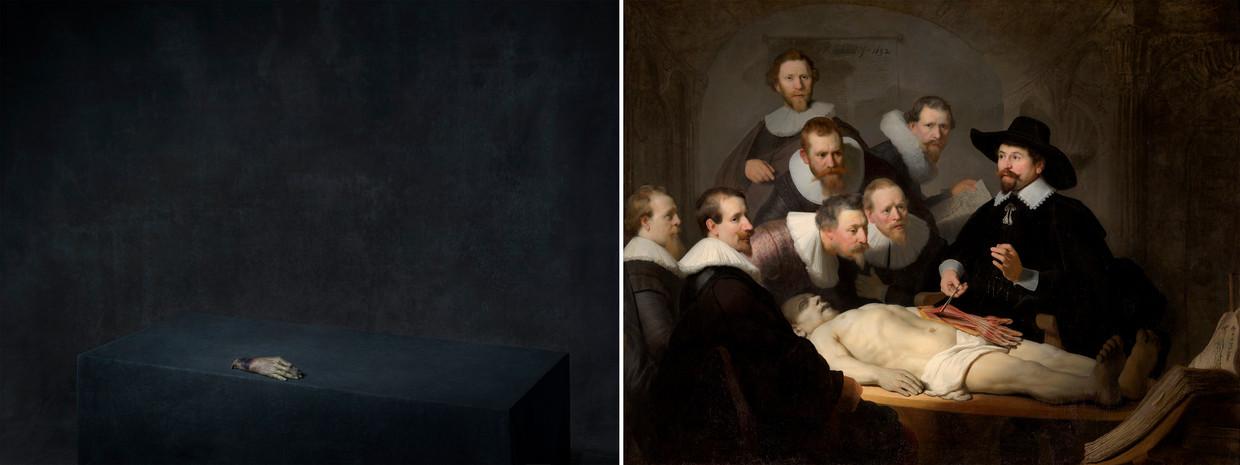
Er werd nog verder ingezoomd op de voorstelling, naar een detail dat er eigenlijk niet meer zou mogen zijn: de rechterhand van het dode lichaam. Aris Kindt is tweemaal veroordeeld geweest. Bij de tweede keer, na het stelen van een mantel, is hij veroordeeld tot de galg en werd zijn lichaam geschonken aan de wetenschap. Zo is hij op de snijtafel van dokter Tulp beland. Maar bij de eerste veroordeling al werd zijn rechterhand afgehakt. Die hand heeft Rembrandt dus niet kunnen waarnemen. In de eerste opzet van het schilderij heeft Rembrandt een stomp geschetst. Door middel van röntgenfotografie is die in een onderliggende verflaag nog te zien. Rembrandt vond de verminking waarschijnlijk te veel afleiden, dus heeft hij er in de afwerkingsfase toch weer een hand van gemaakt. Vanfleteren koos ervoor “het door Rembrandt nooit geziene te willen tonen, en de rest zie je niet”.
Om de compositie van het schilderij en het perspectief van het lichaam te onderzoeken is Vanfleteren zelf op een tafel gaan liggen. Puzzelen, passen en meten. Met als conclusie: er klopt wiskundig niets van de verkorte weergave van Kindt. Het lijk ligt zo gedraaid dat zijn hoofd eigenlijk van de tafel zou moeten vallen. De uitdaging bestond erin de juiste synergie tussen het schilderij en de foto te creëren. “Je brein maakt de hand op de foto groter, omdat er verder weinig te zien is. Maar in werkelijkheid zijn de rechterhanden op het schilderij en de foto even groot.”
Deze snijles – we zien het moment waarop Tulp zijn vakgenoten de buigspieren van de vingers demonstreert – vond plaats in de Waag in Amsterdam. Een anatomische les met een echt lichaam werd eens per jaar toegestaan, en alleen in de winter, anders ging het ontbindende lichaam te veel stinken.
“Van iedereen op het schilderij weten we wie het is, ook van de man op de snijtafel. De hand op de foto is anoniem. De eigenaar ervan is niet bekend. Het was een man, meer weet ik niet. De hand heeft geleefd: gestreeld, geschreven, vastgehouden, geschud en wellicht gevochten. Wat onderscheidt ons mensen van dieren? Ons brein, ons hoofd én het gebruik van onze handen. De fijne motoriek zit in de handen, waardoor deze lichaamsdelen een hogere status toegedicht wordt dan voeten of knieën ooit zullen krijgen.”
“In Rembrandts tijd was het geloof nog heel belangrijk en de dood was veel meer verweven met het leven. De wetenschap won in de zeventiende eeuw aan belang. Precies toen werd een kentering van geloof naar wetenschap ingezet, van ‘God heeft jou geschapen’ naar ‘wij zijn van God losgekomen’. Daar zijn we nu. Vandaag rust er een taboe op de dood, maar niemand kan de dood ontlopen.”
Tekst geschreven door Martine Gosselink & Hedwig Wösten (Mauritshuis, Den Haag)
English version
Stephan Vanfleteren paused in the doorway of the first Rembrandt room (the Mauritshuis has two Rembrandt rooms) and fell silent at the sight of The Anatomy Lesson of Dr Nicolaes Tulp. “It was a momentous meeting.” The painting is an icon in which three fascinations of the photographer come together: nudity, death and religious art.
As his career progressed, Vanfleteren started photographing nudity more and more often. Death has intrigued him since childhood, but without fear. As he grows older and realises that there is less time ahead of him than behind him, an intimation of death is growing. The more he captures images of death, the greater his zest for life becomes, as does his gratitude and awareness of the ticking of time. So he seizes the day and lives life more intensely.
The connection between The Anatomy Lesson and the third fascination, religious art, is less immediately obvious. In Vanfleteren’s homeland, Belgium, the churches are full of religious imagery; the suffering and bleeding body of Christ. These paintings and sculptures are still worshipped at today.
Vanfleteren sees the same religiosity in this work by Rembrandt. Only here it is not Christ that is being worshipped, but science. In the centuries when the Catholic faith reigned supreme in The Netherlands, the cutting of human bodies was anathema. One didn’t cut into the flesh created by God. That changed with the rise of Protestantism. Cutting and examining the human body was allowed, as long as the guinea pig was not a good citizen. Only the bodies of thieves and other criminals were dissected.
And then there was one more connection between the painting and Vanfleteren. That is the name of the man whose arm is being cut: Aris Kindt. Vanfleteren’s mother bears the same surname. “I had no choice in the matter, this was my painting.” Vanfleteren’s focus is entirely on this man Aris Kindt, who is the subject in more than one way – even though dead. To him the corpse is more interesting than the surgeons. “The doctors would have been surprised, in fact they may even have been resentful.” Vanfleteren is probably right about that, after all, it was the surgeons who commissioned Rembrandt to make this group portrait.
He narrowed his focus even more, onto a detail that shouldn’t really be there: the right hand of the dead body. Aris Kindt was a double convict. The second time, after stealing a cloak, he was sentenced to the gallows and his body was made available to science. That’s how he ended up on Dr Tulp’s cutting table. But his right hand had been cut off upon his first conviction. In other words, it would have been impossible for Rembrandt to observe that hand. Indeed, in the first version of the painting Rembrandt had sketched a stump. It can still be seen by means of X-ray spectrometry in an underlying paint layer. Rembrandt probably decided the mutilation was too distracting, so he made a hand of it again during the finishing stage. Vanfleteren chose “to show what Rembrandt had not seen, and not show the rest”.
To investigate the composition of the painting and the perspective of the body, Vanfleteren himself lay down on a table. Puzzling, fitting and measuring. Whereupon he reached the conclusion: there is nothing mathematically correct about Kindt’s foreshortened representation. The corpse is so twisted that his head should actually be falling off the table. The challenge was creating the right synergy between the painting and the photograph. “Your brain makes the hand in the photo bigger, because there is little else to see. But in reality, the right hands in the painting and the photograph are exactly the same size.”
This anatomy lesson – we see the moment when Tulp demonstrates the flexor muscles of the fingers to his colleagues – took place in the Waag in Amsterdam. An anatomy lesson with a real body was allowed once a year, and only in winter, otherwise the rotting body would start to stink too much. “We know who everyone is in the painting, including the man on the cutting table.
The hand in the photograph is anonymous. Its owner is unknown. It was a man, that’s all I know. The hand has lived: caressing, writing, holding, shaking and perhaps fighting. What distinguishes us humans from animals? Our brain, our mind and the use of our hands. The fine motor skills are in the hands, which gives them a higher status than our feet or knees will ever have.”
“In Rembrandt’s time, religion was still very important and death was much more intertwined with life than today. Science became increasingly important in the seventeenth century. That’s precisely when a pivot from faith to science began: we moved from God created you, to becoming separate from God. That’s how we are now. Today death is a taboo subject, but no one can escape death.”
Text written by Martine Gosselink & Hedwig Wösten (Mauritshuis, The Hague)